

How Did the Baby Boomers Become the Generation Everyone Blames?

In 2021, my partner and I moved into a two-bedroom apartment in Columbus for $1,150 a month. Weeks later, on a family video call, my mother asked when the wedding was. In her timeline, marriage and a house came early. In mine, the rent came first, and everything else waited.
That gap between two sets of expectations is real, and online it usually gets one name: boomers. In 2026, the oldest of them turn 80, and the argument over what they took and left behind is louder than ever.
So why are baby boomers blamed for so much, and how much of it holds up?
Why Are Baby Boomers Blamed?

Baby boomers get blamed because they hold about half of America’s household wealth, own a large share of its family-size homes, and built that lead during decades of rising home and stock prices that younger adults missed.
| Reason | What younger adults see | What the data says |
| Wealth | One generation holding most money | Boomers held 52.5% of US household net worth in the second quarter of 2026 |
| Housing | Family-size homes rarely for sale | Empty-nest boomers own 28% of homes with three or more bedrooms; millennial parents own 16% |
| Retirement costs | Bills landing on younger workers | Social Security’s retirement trust fund is projected to run out of reserves in late 2032 |
| Culture | Being called lazy or entitled | The 2019 “OK boomer” meme made the frustration a two-word comeback |
That’s the case for the prosecution. Whether it adds up to a guilty verdict is what the rest of this piece checks.
The Wealth Gap Is Real, but It Lives Mostly at the Top
Boomer households held $97.4 trillion in the second quarter of 2026 while heading only about 30% of US households, Fortune reported from Federal Reserve data. The fine print sits in a February 2026 Pew Research Center analysis: in 2022, the top 10% of boomer households held 71% of the generation’s wealth.
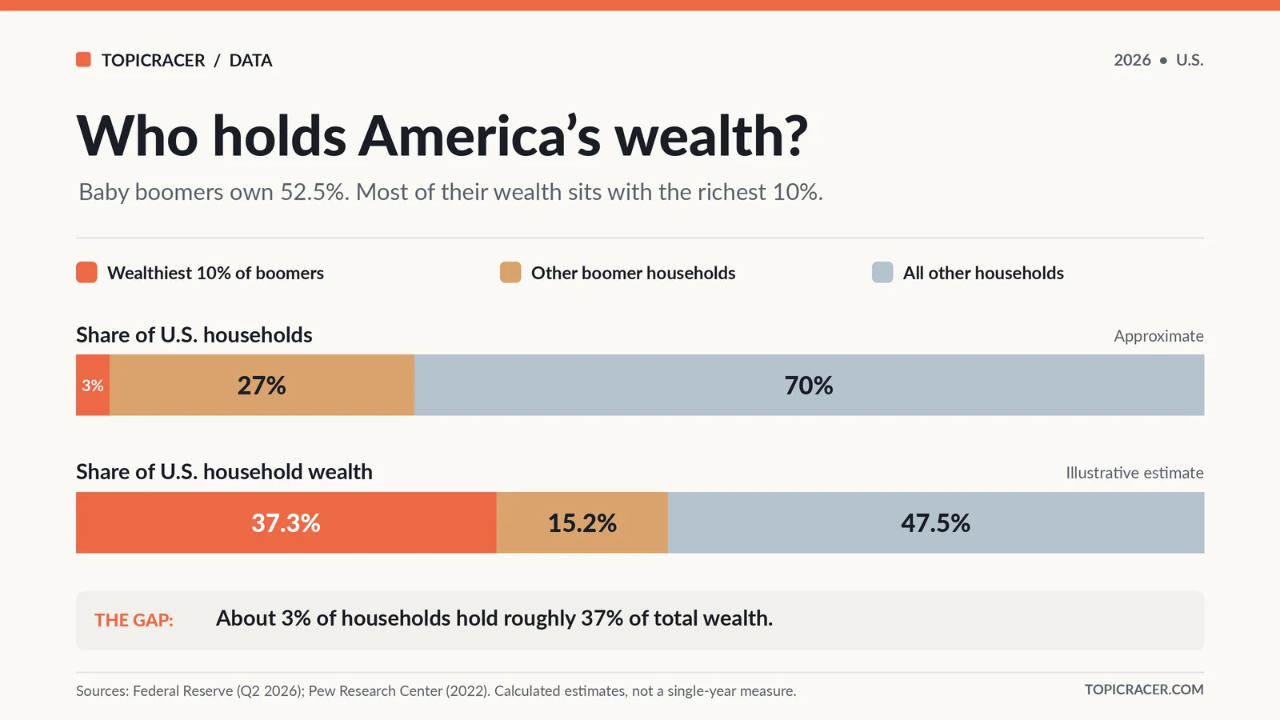
Combining those figures is my own rough math, mixing a 2022 survey with 2026 totals, so treat it as an estimate:
- 71% of 52.5% means about 37% of all US household wealth sits with the richest tenth of boomer households.
- Those households are roughly 3% of all US households.
- The other 90% of boomer households, about 27% of all households, hold roughly 15% of the wealth, less than their share of households.
So “boomers are rich” is mostly a statement about a few million households.
Housing Is Where the Resentment Gets Personal
Wealth stays abstract until you tour houses. A Redfin analysis of 2024 Census data, reported by Axios in May 2026, found that empty-nest boomers own 28% of US homes with three or more bedrooms, while millennials with kids own 16%. Many have no mortgage or a rate locked in years ago, so selling makes little financial sense.
A separate Pew survey found that 87% of Americans believe young adults face greater difficulty buying a home than their parents did, up from 70% in 2021.
Fascinating WSJ story showing that many Booomers are not only not downsizing their homes, they’re instead upsizing and getting large ones. Empty-nest baby boomers own 28% of U.S. homes with three bedrooms compared with 16% for millennials with children.
https://t.co/RXhHleMFAA
— Andrew Kaczynski (@KFILE) July 17, 2026
Columbus, my city, is supposedly the good news. It’s one of the metros where millennial parents own the biggest share of large homes, at roughly 19%. That’s the national best case, still under one in five.
Did you know? Ten years ago the gap looked even wider. Millennials owned around 5% of large US homes in 2014 and 16% in 2024, partly by buying houses from the Silent Generation, according to the same Redfin analysis.
How the Blame Went Mainstream
Boomer blaming didn’t start on TikTok. Sociologist Jennie Bristow analyzed British newspapers from 1986 to 2011 and found that boomers were framed as a problem only fairly recently, first an economic one and then a cultural one. Here’s the rough timeline:
- 2006: British papers float “Boomergeddon,” a panic about boomer retirements and pension costs.
- 2010: UK minister David Willetts publishes The Pinch, arguing that boomers took their children’s future.
- June 2016: After the Brexit vote, older Leave voters become the villains, though polling Bristow cites shows just under two-fifths of UK boomers voted Remain.
- October and November 2019: “OK boomer” jumps from TikTok to The New York Times and then to New Zealand’s Parliament.
Two of those milestones happened in Britain. The American version borrowed much of its script. The age-based jokes never stopped. The term “unc” has also become a way to tease millennials about their age, despite its much older roots.
Who Counts as a Baby Boomer Depends on Whose Chart You Use
I keep a spreadsheet of birth-year ranges for every generation. I started it in 2019, after three textbooks gave me three different ranges for millennials, and it now holds about 40 sources. The boomer row is one of the few that mostly agrees, though some researchers, especially in Britain, use 1945 to 1965 instead.
Labels also miss the people inside them. My parents were born in the mid-1960s and emigrated from Chennai in 1992. On paper they’re Gen X, yet nothing about their lives fits the latchkey, MTV script.
Pew Research Center defines baby boomers as Americans born from 1946 through 1964, a span that produced 76 million US births. By Pew’s own count, a typical generation spans 15 to 18 years, which leaves plenty of room for differences inside it.
View this post on Instagram
Are Baby Boomers to Blame?
I’m not an economist, so I’ll report what researchers found, then where I land. The critique holds on timing: many boomers bought homes and stocks before decades of rising prices.
Even boomer writers concede the politics. Paul Taylor, a former Pew executive and a boomer himself, wrote in 2025 that boomer candidates had won eight of the last nine presidential elections.
But two findings from the same Pew analysis complicate the indictment:
- Boomer households without a bachelor’s degree are not wealthier than similarly educated older households from earlier generations, after adjusting for inflation.
- Boomers with some college had a median net worth of $330,500 in 2022, below the $527,700 for similar households in 2001, both in 2024 dollars.
To me, that reads as a story about education and class at least as much as birth year.
Why Generational Blame Keeps Happening

In 2016, during my student teaching, a Gen X supervising teacher warned me that “these kids can’t focus.” The same kids then held a 40-minute debate on whether a hot dog is a sandwich. Blame runs downhill as easily as uphill.
Bristow argued in 2025 that generational labels turn real economic problems into morality plays and let policymakers off the hook. The labels keep multiplying.
McCrindle, the Australian firm that coined Gen Alpha, now calls babies born from January 2025 onward Gen Beta. My friend’s January 2025 baby technically qualifies and already has a photo account run by the grandparents.
Research note: A cohort effect comes from when you were born. A period effect hits every age at once, like a recession. I’d argue that much of what gets pinned on boomers is the second kind.
Important Questions to Ask:
1. Will Social Security stop paying benefits after 2032?
No. Depletion means reserves run out, not that checks stop. Payroll taxes would still cover about 78% of scheduled retirement benefits, per the 2026 trustees’ projections.
2. Are baby boomers wealthier than earlier generations of retirees?
Yes. Pew found boomer households aged 58 to 76 had $432,200 in 2022, versus $335,900 for that age group in 2001, in 2024 dollars.
3. How many baby boomers are still alive?
About 67 million as of July 2024, roughly 20% of Americans, by Pew’s count of Census estimates. The Census Bureau projects about 1 million by 2062.
4. Did boomers always vote as a liberal bloc?
No. Paul Taylor notes that in 14 presidential elections from 1972 through 2024, most boomers backed the Democrat only once, Jimmy Carter in 1976.
5. How much wealth do millennials and Gen Z hold?
About 11.2% of US household net worth in the second quarter of 2026. The Fed counts everyone born in 1981 or later as millennial, so Gen Z is folded in.
What the Boomer Label Explains, and Where It Breaks

The Fed’s next quarterly wealth update will almost certainly show boomers still holding more than half of US household wealth. It will get screenshotted as proof, and it is proof of something. A four-decade asset boom rewarded people who owned assets early, and the richest tenth of baby boomers captured most of it.
What it doesn’t prove is that the roughly 67 million boomers counted in 2024 share one bank balance or one set of politics. My parents, technically Gen X, never got the generational memo either. When the next chart goes viral, check who sits in that top tenth before blaming the whole row.