

In 2021, Americans Split Over Whether Young Adults Had It Easier Finding Work. Now 64% Say It’s Harder

For most of 2021, the electronics store where I sold phones kept a Now Hiring sign taped next to the door. Managers interviewed people between customers, and a teenager I referred got an offer within a week. I was 19 and assumed that was normal.
It was not normal, and Americans now see the difference. In October 2021, people split almost evenly on whether young adults had it easier or harder finding a job than their parents did.
In May 2026, 64% said harder and only 15% said easier. I have job hunted on both sides of that line.
What Pew Found About Finding a Job

The new numbers come from a Pew Research Center survey of 10,091 U.S. adults conducted May 4 to 17, 2026, and published July 17. Pew asked whether several milestones are harder or easier for young adults today than they were for their parents’ generation.
On finding a job, 64% said harder, 15% said easier and 20% said about the same. The comparison point is a survey of 9,676 adults from October 18 to 24, 2021, when 40% said easier, 39% said harder and 21% said about the same.
Among the four financial milestones Pew compared across both surveys, finding a job was the only one in 2021 where slightly more Americans said young adults had it easier than harder. By 2026, the harder side had grown by 25 percentage points.
How 2021 Looked From the Phone Floor
The 2021 optimism had numbers behind it. The Bureau of Labor Statistics counted 11.0 million job openings in October 2021, the same month Pew ran its first survey. Employers added 531,000 jobs that month, according to the October 2021 jobs report.
#US employers added 531,000 jobs in October, with #unemployment rate dropping to 4.6 per cent, indicating a hiring rebound as the Delta wave weakened, the US Department of Labor (@USDOL) has reported. https://t.co/MrgBY5ok3Z
— IANS (@ians_india) November 5, 2021
On the sales floor, the shortage showed up in small ways. Shifts went unfilled, managers covered breaks, and anyone who could explain an installment plan without reading the card got trained fast. (I got my first raise that year without asking for it.)
My take is that a lot of people who answered easier in 2021 were looking at signs like ours. A tight market makes entry-level jobs visible, because employers are the ones chasing applicants. When hiring slows, those signs come down first, and the people looking for a first job notice before anyone else does.
Every Age Group Moved, and Older Adults Moved Most
Young adults are the most pessimistic group in the 2026 survey, which makes sense, since they are the ones applying. The bigger shift, though, came from people old enough to be their parents. Pew reports these results by age group, not generation, and the center has grown cautious about labels like Gen Z and millennial.
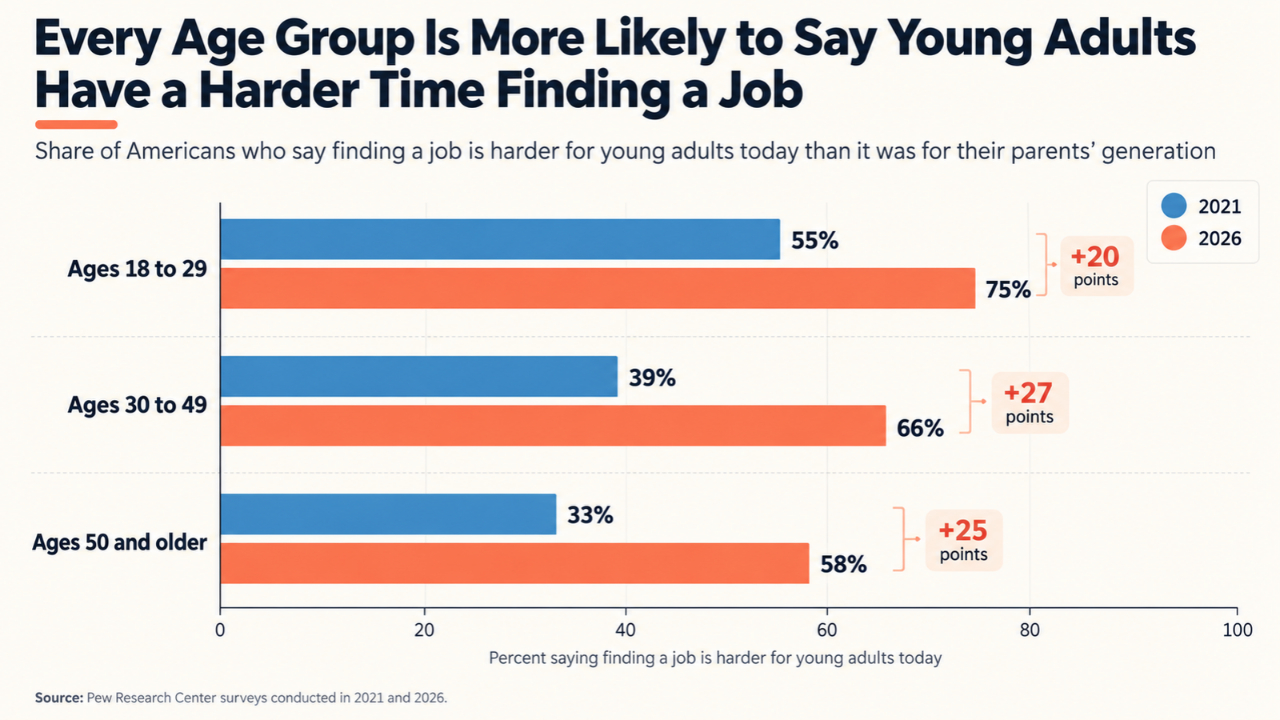
I spent three years watching parents buy first phones, and what parents worry about usually tells you more than what teens post. Here, the parents changed their minds fastest.
The Labor Numbers Behind the Mood
The odd part is that overall unemployment is lower now than when Americans felt better. To see why the mood shifted anyway, I lined up the closest official figures from both surveys.
| Measure | Fall 2021 | Late summer 2026 |
| Unemployment rate | 4.6% (Oct.) | 4.2% (Sept.) |
| Job openings | 11.0 million (Oct.) | 7.1 million (Aug.) |
| Openings per unemployed person | About 1.5 (Oct.) | About 1.0 (Aug.) |
| New entrants looking for a first job | 537,000 (Oct.) | 818,000 (Sept.) |
| Teen unemployment rate | 11.9% (Oct.) | 14.5% (Sept.) |
The openings-per-person row is my own math, openings divided by unemployed people in the same month. The August 2026 openings report and the September 2026 jobs report supply the recent figures. Fewer openings per job seeker and more first-time job seekers hit young people hardest.
Job Hunting in 2025 Felt Different
When my content-writing contracts dried up in early 2025, I kept a spreadsheet of applications, the same way I track my screen time. It ran past 40 rows before anyone called back, and many entry-level listings asked for two or three years of experience.
The official numbers match that feeling. The Federal Reserve Bank of New York puts unemployment for recent college graduates ages 22 to 27 at about 5.6% in the second quarter of 2026, with 42% working jobs that do not require a degree.
View this post on Instagram
Did you know? In the New York City metro area, unemployment for 22- to 27-year-olds with a bachelor’s degree was 7.7% in June 2026, the same as for peers without one, according to a Business Insider analysis of Current Population Survey data.
The Other Milestones Got Harder Too
Finding a job made the biggest jump, but it is not the most pessimistic answer in the survey. The 2026 report compares four milestones with 2021 and adds a fifth.
| Milestone | Harder in 2021 | Harder in 2026 | Change |
| Buying a home | 70% | 87% | +17 points |
| Paying for college | 71% | 82% | +11 points |
| Saving for the future | 72% | 82% | +10 points |
| Finding a job | 39% | 64% | +25 points |
| Covering basic expenses | Not asked | 80% | No 2021 figure |
Homes, college and savings were already seen as harder in 2021, so they had less room to climb. Jobs were the one area where people felt young adults had an edge, and that edge is gone in public opinion. Covering basic expenses, asked for the first time, landed at 80%, so it has no trend line yet.
The gap between generations also fuels the debate over why Baby Boomers get blamed for America’s economic problems.
What Is Confirmed and What Is Still a Guess
A lot of coverage blames artificial intelligence for the weaker entry-level market. Some of that may turn out to be right, but the evidence so far is thinner than the headlines. Here is how the main claims sort out.
- Confirmed. Pew measured opinion, not hiring. The 64% figure shows what Americans believe, which can move faster than the job market itself.
- Confirmed. Openings fell from 11.0 million to 7.1 million, and first-time job seekers rose, in the BLS figures above.
- Still debated. Economic Policy Institute economists wrote in May 2026 that it is too early to blame AI, noting that young workers without degrees saw unemployment rise at a similar pace.
- Subject to change. Recent monthly BLS figures are preliminary and get revised, so the September numbers could still move.
What the Numbers Mean if You Are Looking for Work
None of these figures says a young job seeker cannot get hired. They do say the search tends to take longer and the first offer may come from a job that does not use every skill on the resume.
- Plan for a longer search. The September 2026 report counted about 1.9 million people unemployed for 27 weeks or more.
- Watch hiring, not just openings. Employers made about 5.2 million hires in August 2026, compared with about 6.5 million in October 2021.
A degree still matters over a career, but the early advantage looks smaller than it did in 2000, and nobody should read a quiet inbox in month two as a verdict.
Read the BLS tables for your own age group before you trust a viral post about them.
What to Watch Next

The next test comes on November 6, 2026, when the Bureau of Labor Statistics releases the October jobs report at 8:30 a.m. Eastern. Check the new entrants line and the teen unemployment rate, not only the headline number, because those two show first-time job seekers more clearly.
Pew has not announced when it will ask the question again. If openings stay near one per unemployed person through next spring, I expect the harder side to hold. If you are job hunting this fall, start your own spreadsheet now. Mine was the only honest record of how long my search actually took.