
Even Pew Research Has Grown Cautious About Labels Like ‘Gen Z’ and ‘Millennial’

My spreadsheet of generational birth years holds about 40 sources now, and two rows near the top have bothered me for years. Both come from Pew Research Center, the Washington nonprofit whose chart most of the internet copies.
A Pew survey in 2015 counted anyone born from 1981 through 1997 as a millennial. By 2018, Pew ended the group in 1996 instead, and almost nobody noticed a year of babies quietly switching teams.
Then, on May 22, 2023, Pew said it would use labels like Gen Z and millennial far less often. I was born in 1995, right where researchers argue about the line, so I read that announcement twice.
What Pew Actually Announced in May 2023
Pew Research Center officially stopped using these generational labels in May 2023. The reason: when researchers actually run the numbers, the categories do not survive contact with data.
The framework comes from a 1991 book by Strauss and Howe proposing 80-year cyclical generational personalities. University of Maryland sociologist Philip Cohen got hundreds of demographers to sign an open letter calling the labels “arbitrary” with “no scientific basis.” His point: only the Baby Boom is a real demographic event tied to a measurable birth-rate spike. The rest were named ad hoc by marketers and journalists.
The empirics are worse. When Pew tested the actual claim that Millennials are job-hoppers, they found Millennials and Gen X switch jobs at the same rate. The 2021 YouGov survey for The Atlantic found only 39% of Gen Z respondents felt they could relate to the label assigned to them. The “generational personality” is a measurement artifact: within-generation variance dwarfs between-generation variance on almost every value or behavior measured.
What actually shapes the cohort everyone calls Boomers is a 30-year price environment: 4% mortgages on $30K homes, single-income households buying 1,500 square feet, defined-benefit pensions covering retirement. “Work hard, stay loyal” was not a worldview. It was the rational response to a labor market where 35-year tenure paid out a guaranteed annuity.
Same for Millennials. “Follow your passion” tracks perfectly with the only cohort that graduated into 30 years of flat real wages, $1.7T in student debt, and a credentialing race that made trade jobs feel like failure. Different prices, different mottos.
These lists go viral because they let everyone confirm a story they already tell about themselves. They keep going viral because the actual finding (it’s prices, not personalities) does not fit on a graphic.
— Aakash Gupta (@aakashgupta) April 21, 2026
The announcement came from Kim Parker, director of social trends research, in a post explaining how Pew will report on generations from now on. It followed a yearlong review, and Pew did not withdraw its older generational reports.
What changed is the bar for new work, set by four rules.
- Compare generations only with long-running data that shows each group at the same life stage, such as decades of U.S. Census Bureau surveys.
- Account for period effects and demographic shifts, such as growing racial and ethnic diversity, before crediting a gap to generation.
- Report plain age differences when a true generational comparison is impossible.
- Try other groupings when they fit better, such as birth decade or the first presidential election a person could vote in.
Pew also expects to publish much less generational research overall. It described much of the field as closer to clickbait than research.
The Group That Drew the 1996 Line Is Now Hedging
The announcement mattered because Pew is the source most people use, whether they know it or not. The 1981 to 1996 millennial range on nearly every quiz I have saved traces back to a 2019 Pew explainer on where millennials end and Generation Z begins.
| Date | What Pew did |
| September 2015 | Surveyed 3,147 adults using a 1981 to 1997 millennial range |
| March 2018 | Moved the last millennial birth year to 1996 |
| January 2019 | Published the explainer behind the familiar chart |
| May 2023 | Announced new limits and tested its own findings |
| April 2025 | Updated its guide to reading generational research |
The 2019 explainer now opens with a note from the editors saying the Pew approach has changed. Even back then, Pew called 1996 a judgment call. A senior born in 2001 once asked me why the line sat at 1996, and in 2018 I had no better answer.
Age, Period and Cohort, Explained Without a Stats Degree
The heart of the change is a distinction researchers have argued about for decades. When younger adults answer a survey differently from older adults, there are at least three possible reasons, and only one of them is about generation.
Age effect means people change as they move through life stages. Period effect means an event, such as a recession or a pandemic, shifts everyone at once. Cohort effect means people born in the same years carry a lasting difference from shared formative experiences.
A one-time survey cannot separate those three. If 25-year-olds rent more than 50-year-olds in 2026, the cause could be being 25, facing 2026 housing prices, or being Gen Z, and a single snapshot cannot tell you which.
Another Pew survey illustrates the problem. Smartphone-related sleep loss varies sharply by age, with 62% of adults under 30 reporting a negative effect versus 14% of adults 65 and older. The gap is real, but a single survey cannot establish a permanent generational trait.
I am not a statistician, so I lean on how Pew frames it. Parker wrote that public conversation often skips this separation, which strikes me as generous.
What Happened When Pew Tested Its Own Findings
Pew ran its test on almost 60 years of Current Population Survey data, collected by the Census Bureau from 1962 to 2021. It applied age-period-cohort analysis, a method that tries to pull those three effects apart, to two well-known millennial findings.
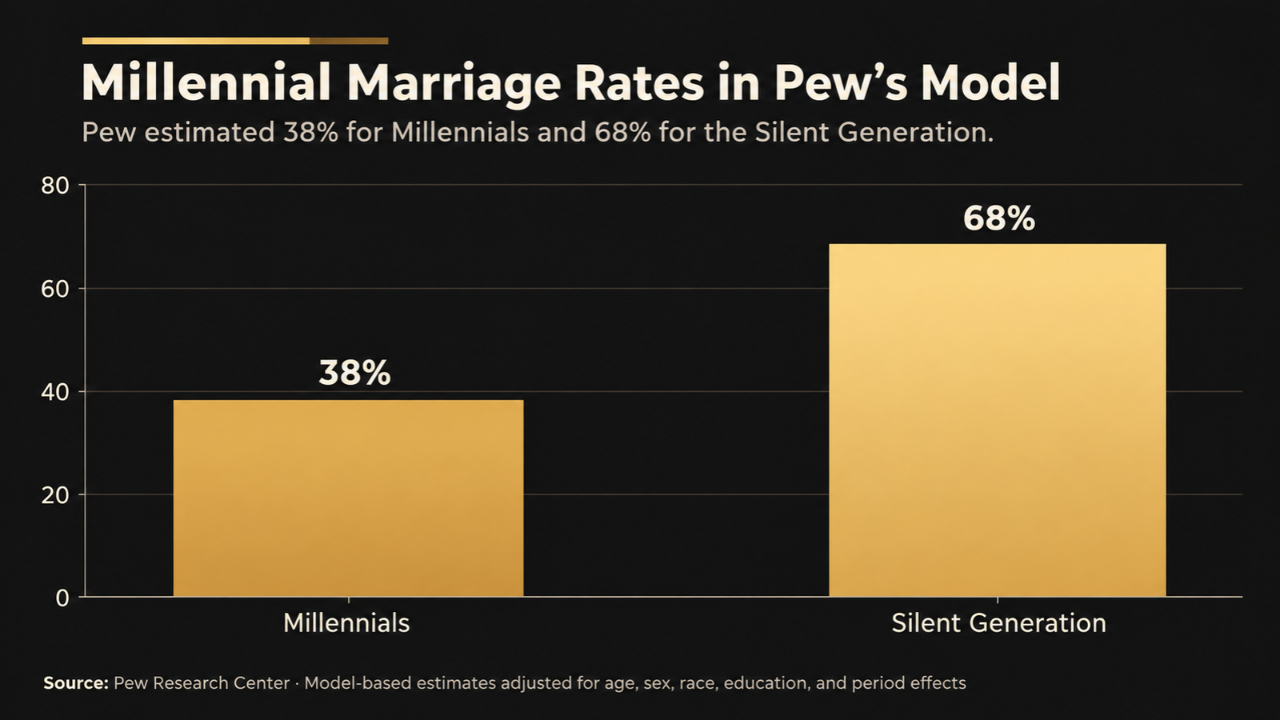
The first finding held up. After controlling for age, sex, race, education and period, Pew estimated that about 38% of millennials would be married, compared with 68% of the Silent Generation.
My mother would appreciate that number. In 2021, the week my partner and I signed a $1,150 lease on a two-bedroom, her first question on the family video call was about a wedding date.
The second finding did not survive. Earlier Pew work suggested millennials move less than past generations did, but in the new model the generational gap vanished, and factors such as race and education accounted for it.
Most People Do Not Even Pick Their Assigned Label
View this post on Instagram
Labels also fail a simpler test, which is whether people recognize themselves in them. In a 2015 Pew survey of 3,147 adults, only 40% of millennials, then ages 18 to 34, considered themselves part of that generation, and 33% chose Gen X.
A YouGov poll of about 13,000 U.S. adults, fielded in early 2024, found a similar pattern. Overall, 58% identified with their Pew-defined generation, but only about four in 10 people born since 1981 did.
Did you know? In a Skidmore College survey of 1,478 Americans, reported by sociologist Philip Cohen, people born close to a generational boundary were the most likely to name the wrong generation.
My test-prep students, born 2006 to 2008, say Gen Z when asked, with total indifference. My cousin, born in 1999, insists I am basically Gen Z, and no survey item I know of settles the argument.
The rise and decline of the 6-7 meme offers another example. The phrase became closely associated with Gen Alpha, but its popularity changed far faster than any generation could. A viral joke tells us something about a cultural moment, not necessarily everyone born within a particular set of years.
Where the Labels Came From in the First Place
Only one modern American generation rests on a measurable demographic event. Critics point out that the baby boom was a real spike in U.S. births after World War II, roughly 1946 through 1964, while the later labels came from writers, researchers and marketers.
The same cohort now sits at the center of the debate over why Baby Boomers get blamed for America’s economic problems.
Millennial spread through the work of William Strauss and Neil Howe, whose 1991 book Generations described American history as a cycle of generational types. Generation X took its popular name from a 1991 Douglas Coupland novel.
The Xennial label offers another example. It covers people born between 1977 and 1983, right at the boundary of Gen X and Millennials.
Even the agency that counts us stays out of it. In a 2015 blog post, the Census Bureau said it does not set the birth years for millennials.
I started my spreadsheet in 2019, after three textbooks on my classroom shelf gave three different millennial ranges. None of them said where its range came from.
Critics Say Pew Did Not Go Far Enough

Pew did not change course in a vacuum. In July 2021, University of Maryland sociologist Philip Cohen published a Washington Post op-ed backed by an open letter from about 150 demographers and social scientists, urging Pew to retire the labels.
Not everyone was convinced in 2023.
- Cohen welcomed the steps but noted Pew tested only its standard categories, not whether birth years should be grouped that way at all.
- A Forbes contributor flagged the caveat in the new stance, since Pew can still use labels whenever the data seems to fit.
- Marketing Week columnist Mark Ritson argued that generational segments fail marketers too, citing a 2019 Harvard Business Review analysis that found small workplace differences between generations.
The argument also went abroad. In February 2025, the Australian radio show Future Tense compared the labels to astrology, with Cohen and Bobby Duffy of King’s College London as guests.
How to Read a Generational Headline Now
None of this makes the labels useless. A shorthand helps when a cohort truly lived through something together, like graduating into the 2008 recession or starting high school on Zoom in 2020, which I watched as a teacher.
The millennial pause shows how easily an everyday habit can become a generational stereotype. A brief silence before someone speaks on camera became a supposed millennial trait, even though older and younger people do it too.
Pew also published five things to keep in mind about generations, last updated in April 2025. My own checklist sits next to the n = ? sticky note on my monitor.
- Which birth years does the source use, and does it say so?
- How many people answered, and when was the survey fielded?
- Does it compare age groups today, or the same life stage across decades?
- Did the researchers account for race, education or income?
- Who paid for the study, and do they sell something to that generation?
A good example is Pew’s 2026 employment survey, which found that 75% of adults ages 18 to 29 believe young adults face greater difficulty with jobs than their parents did.
A headline that fails the first two questions is a horoscope with the sample size missing. Plenty still run every week.
A similar problem appears in claims that kids no longer read books. A 2019 psychology study found that avid adult readers were especially prone to believe children had lost interest in books.
Our review of Cuffing Season shows how popular claims about seasonal romance can spread without verifiable data.
A Label That Arrived Before Her First Word
@fixyourenglishnowWhich Gen are you? 👀 GEN G GEN S GEN B GEN X GEN Y GEN Z GEN ALPHA GEN BETA From the Greatest Generation to Gen Beta, every generation has its own identity, experiences and cultural references. How many of these generation labels did you already know? Save this reel and share it with someone from a different generation! ✨ LearnWithAshmeet♬ original sound – English lessons
My friend had a daughter in January 2025, which technically makes her one of the first members of Gen Beta, a name Australian researcher Mark McCrindle gave to babies born from 2025 through 2039. She has a photo account run by her grandparents and no opinions about any of it yet.
When I update my spreadsheet this week, every Pew row gets a new column marking whether the finding separated age, period and cohort, since Pew now holds its own work to that standard. Her label arrived before her first word. The data to justify it will take about 20 years to collect.